Rankings can change quickly, and finding out about a drop from a client instead of your rank tracking tool is never ideal. The best rank tracking tools monitor keyword positions consistently, identify significant changes, and give SEO teams the data they need to respond quickly.
For SEO agencies like Version, rank tracking is an important part of managing SEO campaigns and measuring performance. That experience has shown that the right tracking tool needs to do more than report positions. It should provide reliable data, useful alerts, local and competitor tracking, and reporting that makes SEO performance easy to understand.
This guide compares five of the best rank tracking tools in 2026, looking at accuracy, update frequency, features, reporting, and value to help you choose the right option for your SEO workflow.
1. SE Ranking
SE Ranking earns the top spot because it offers a strong balance of price, accuracy, and features. The rank data is reliable, local tracking supports detailed geographic targeting, and daily tracking is available for standard campaigns.
Beyond keyword rank tracking, you get a site audit, backlink monitoring, and keyword research in the same subscription. For freelancers and small agencies trying to keep software costs under control, that consolidation can be useful. Its white-label reporting is also valuable for agencies that need to deliver branded SEO reports.
The tradeoff is the interface. It is feature-heavy, and finding a specific view can take more clicks than necessary. New users may need some time to get familiar with the platform.
Pros
- Accurate daily tracking with local targeting
- Full SEO toolkit included in one subscription
- Strong white-label reporting for agencies
- Flexible tracking options based on keywords and frequency
Cons
- Busy interface can slow down routine tasks
- Alerts are less immediate than some dedicated trackers
- Costs increase as keyword volume and tracking frequency increase
Best for: Freelancers and small agencies that want one platform for rank tracking and most of their SEO workflow.
2. AccuRanker
AccuRanker is one of the strongest dedicated rank tracking tools for agencies that prioritize update speed and detailed keyword analysis. Positions update daily, and users can refresh keywords on demand, which is useful when monitoring the impact of recent SEO changes.
The segmentation is excellent. You can organize and filter data by tags, landing pages, search intent, and other attributes. Its Share of Voice metric also gives agencies a straightforward way to communicate changes in organic visibility, while integrations with reporting platforms such as Looker Studio support established agency workflows.
The main drawback is price. AccuRanker is designed for professional SEO teams, and costs increase as keyword requirements grow. It also focuses primarily on rank tracking, so users will need separate tools for areas such as site auditing and broader keyword research.
Pros
- Fast rank updates with on-demand refreshes
- Share of Voice and visibility metrics
- Detailed tagging and segmentation
- Strong reporting, API, and Looker Studio integrations
Cons
- Costs increase significantly at larger keyword volumes
- Advanced data can be more useful to experienced SEOs
- No full SEO toolkit included
Best for: Established agencies and SEO teams managing large keyword sets that need frequent, detailed ranking data.
3. Semrush
Semrush is less a dedicated rank tracker and more a complete SEO platform with keyword tracking built in. Its Position Tracking tool covers daily ranking updates, SERP feature monitoring, local tracking, historical data, and competitor comparisons.
The main argument for Semrush is the wider toolkit. Keyword research, site audits, backlink analysis, content tools, competitor research, and rank tracking all live within the same platform. If your team already uses several of these features, having ranking data in the same system can simplify the workflow.
As a dedicated rank tracker, however, Semrush is less specialized than AccuRanker. Keyword and project limits also vary by subscription, and users who only need basic position tracking may find the platform more extensive than necessary.
Pros
- Daily position tracking and SERP feature data
- Broad SEO toolkit covering research, audits, and content
- Strong competitor visibility reporting
- Extensive keyword and competitive data
Cons
- Can be expensive for smaller teams
- Keyword and project limits vary by plan
- More features than necessary if you only need rank tracking
Best for: SEO teams that want keyword tracking integrated with a broader SEO and content workflow.
4. Ahrefs Rank Tracker
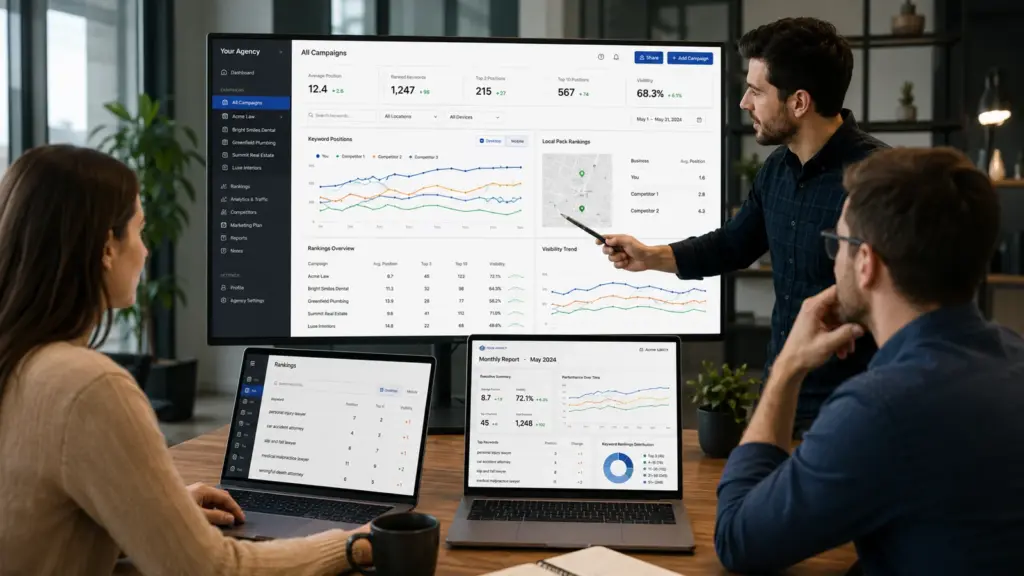
Ahrefs Rank Tracker is a strong choice for teams already using Ahrefs for keyword research and backlink analysis. Its tracking interface provides position history, visibility metrics, SERP features, and competitor comparisons.
The main benefit is keeping ranking data within the same platform as your other SEO research. Historical graphs also make it easier to demonstrate long-term ranking trends and evaluate whether optimization work is producing sustained results.
The main weakness is update frequency on some plans. Users with lower-tier subscriptions may have less frequent ranking updates, while daily tracking can require a higher subscription. For teams that need frequent monitoring, this can make Ahrefs more expensive than a dedicated tracker.
Pros
- Trusted SEO data and historical reporting
- SERP feature and competitor tracking
- Strong integration with Ahrefs’ broader SEO tools
- Clean interface for monitoring long-term trends
Cons
- Update frequency varies by plan
- Daily tracking can require a higher-priced tier
- Alerting is less specialized than dedicated rank trackers
Best for: SEOs already using Ahrefs who want rank tracking integrated with their existing SEO research.
5. Wincher
Wincher is the budget-friendly choice for users who want straightforward daily keyword tracking without the complexity of a full SEO platform. Setup is simple, the interface is easy to navigate, and the core ranking data covers the needs of many small websites.
Competitor tracking adds useful context. You can compare your rankings with competing domains and see how visibility changes over time, making ranking movements easier to explain to non-SEO stakeholders.
The limitations become more noticeable with advanced reporting and larger campaigns. Reporting customization and integrations are more limited than the leading agency-focused platforms. For simple monitoring, however, that may not be a problem.
Pros
- Affordable option for basic rank tracking
- Daily keyword tracking
- Simple, beginner-friendly interface
- Competitor comparison included
Cons
- More limited reporting customization
- Fewer integrations than larger platforms
- No broader SEO toolkit
Best for: Small businesses and solo site owners that need reliable keyword position tracking without a large SEO software investment.
How to Choose a Rank Tracking Tool
Choosing a rank tracker comes down to four main questions.
How Often Do You Need Updates?
If a ranking change can affect traffic or client performance, daily tracking is a sensible baseline. Teams that need to investigate changes immediately after an SEO update should consider a tool with on-demand refreshes.
How Many Keywords and Locations Do You Track?
Local businesses need geographic tracking, while national and international websites may need thousands of keywords across multiple markets. Compare pricing at your actual keyword volume rather than the entry-level plan.
Who Will Use the Reports?
If clients or executives will see the data, reporting and dashboards matter. White-label reports, scheduled reporting, shareable dashboards, and integrations can reduce the time spent turning ranking data into client updates.
Do You Need Tracking or a Full SEO Suite?
Dedicated tools such as AccuRanker and Wincher focus primarily on rank tracking. Platforms such as Semrush, Ahrefs, and SE Ranking combine tracking with keyword research, audits, backlink analysis, and other SEO features.
If you only need position tracking, a dedicated tool may provide better value. If you need several SEO capabilities, an all-in-one platform may reduce the need for multiple subscriptions.
Frequently Asked Questions
What is the most accurate rank tracking tool?
Accuracy varies by location, device, search engine, and the way each platform collects search results. SE Ranking and AccuRanker are strong options for consistent professional rank tracking, but no third-party tool will perfectly reproduce every search a user sees.
Are free rank trackers worth using?
Free tools can be useful for occasional checks, but they generally offer fewer features, limited historical data, and less frequent updates. For websites where organic traffic contributes significantly to revenue, a paid rank tracker provides more useful monitoring and reporting.
How often should rankings be checked?
Daily tracking is a practical standard for client campaigns and competitive industries. Weekly tracking may be sufficient for smaller or less competitive websites where ranking changes are less time-sensitive.
Can you track local rankings with these tools?
Yes. The five platforms support location-based tracking, although geographic precision and available locations vary by tool and plan. Local SEO users should confirm whether a platform supports the specific city, region, or postal-code level they need.
What is the best rank tracker for agencies?
AccuRanker is a strong choice for larger agencies that prioritize fast updates, segmentation, and reporting integrations. SE Ranking is better suited to smaller agencies that want rank tracking combined with audits, keyword research, and white-label reporting.
Do you need a rank tracker if you already use Google Search Console?
Google Search Console is useful for understanding search performance, but it does not replace a dedicated rank tracker. Search Console provides average position and other first-party performance data, while rank tracking tools allow you to monitor specific keywords, locations, competitors, and ranking changes more systematically.
Conclusion
The best rank tracking tool depends on the size of your campaign, the frequency of updates you need, and whether you want dedicated tracking or a broader SEO platform. SE Ranking offers the best overall balance, AccuRanker is ideal for advanced tracking, Semrush and Ahrefs suit broader SEO workflows, while Wincher is a practical budget option.
The right tool should make ranking changes easier to monitor, understand, and act on.
