If you want your pages to rank on Google, on-page SEO is where everything starts. It’s the part of search engine optimization you have full control over, because it all happens on your own website.
The good news: none of it is magic. Once you understand the main on-page SEO factors, you can go page by page and make improvements that add up fast. This guide walks you through what on-page SEO is, why it’s important, the elements that count, the mistakes to skip, and how to run your own audit step by step.
Let’s start with the basics.
What Is On-Page SEO?
On-page SEO is the practice of optimizing individual web pages so they rank higher in search engines and bring in more organic traffic. It covers everything on the page itself: the content, the HTML behind it, the title tag, the meta description, the headings, the images, and the links.
You’ll sometimes hear it called on-site SEO. Same thing. The idea is simple: you tune each webpage so search engines can understand what it’s about, and so visitors have a good user experience when they land on it.
On-page SEO refers to the work you do on your own site. That’s what separates it from off-page SEO, which covers things like backlinks from other websites. We’ll compare the two later in this guide.
Why On-Page SEO Is Important
Here’s why on-page SEO is important: Google can’t rank what it can’t understand. Your page content, titles, and structure are how Google figures out what your page is about and which searches it should show up for.
A few more reasons it deserves your attention:
- It’s fully in your control. You can’t force another site to link to you, but you can fix your own pages today.
- It helps your rankings directly. Better optimization means a better shot at a higher ranking on the search engine results page.
- It improves clicks. A strong title tag and meta description can lift your click-through rate in the SERPs even before your position changes.
- It helps visitors too. Clear structure, fast load times, and useful content keep people on your site longer.
Strong on-page work also makes every other part of your SEO strategy more effective. Links and content marketing work harder when they point at pages that are already well optimized.
Core Elements of On-Page SEO
These are the elements of on-page SEO that move the needle. Go through them one by one and you’ll cover most of what Google looks at.
1. Title Tags
The title tag is the clickable headline that shows up in search results. It’s one of the strongest on-page SEO factors, so get it right.
Best practices: put your target keyword near the front, keep it under about 60 characters so it doesn’t get cut off, and make every title on your site unique. Write it for humans first. A title people want to click beats a title stuffed with keywords.
2. Meta Descriptions
The meta description is the short summary under your title in the search result. It’s not a direct ranking factor, but it works like ad copy. A clear, inviting description wins the click.
Keep it under about 155 characters, include your keyword once, and say what the reader will get. Each page needs its own description.
3. Heading Structure
Headings (H1, H2, H3) tell both readers and search engines how your page is organized. Use one H1 per page with your main keyword in it, then break the rest into logical sections with H2s and H3s.
Think of your header tags as an outline. Someone skimming your page should get the whole story from the headings alone.
4. URL Structure
Good URLs are short, descriptive, and easy to read. Use your target keyword, keep words lowercase, and separate them with hyphens.
For example, yourstore.com/best-running-shoes beats yourstore.com/p?id=8472&cat=9. A concise URL tells Google and the visitor what the page is about before anyone even clicks.
5. Content Quality and Search Intent
Content is the heart of on-page optimization. High-quality content answers the searcher’s question fully, stays accurate, and is easy to read.
The key concept here is search intent: the reason behind the search. Someone typing “buy running shoes” wants a product page. Someone typing “best running shoes for flat feet” wants a comparison guide. If your page doesn’t match the intent behind your target keyword, it won’t rank no matter how well you optimize everything else. Before you create content, look at what’s already on page one and match that format.
6. Internal Linking
An internal link connects one page on your site to another. Internal links help Google find and index your pages, spread authority across your site, and keep visitors reading.
Link related pages together using descriptive anchor text, the clickable words in the link. “See our guide to keyword research” works. “Click here” doesn’t tell Google anything.
7. Image Optimization
Image SEO has two big jobs. First, use descriptive image file names, like red-running-shoes.jpg instead of IMG_2847.jpg. Second, add alt text to every image. Alt text describes the image for screen readers and helps Google understand it.
Also compress your images so they load fast. Big, heavy image files are one of the most common causes of slow pages.
8. Page Speed and Mobile Friendliness
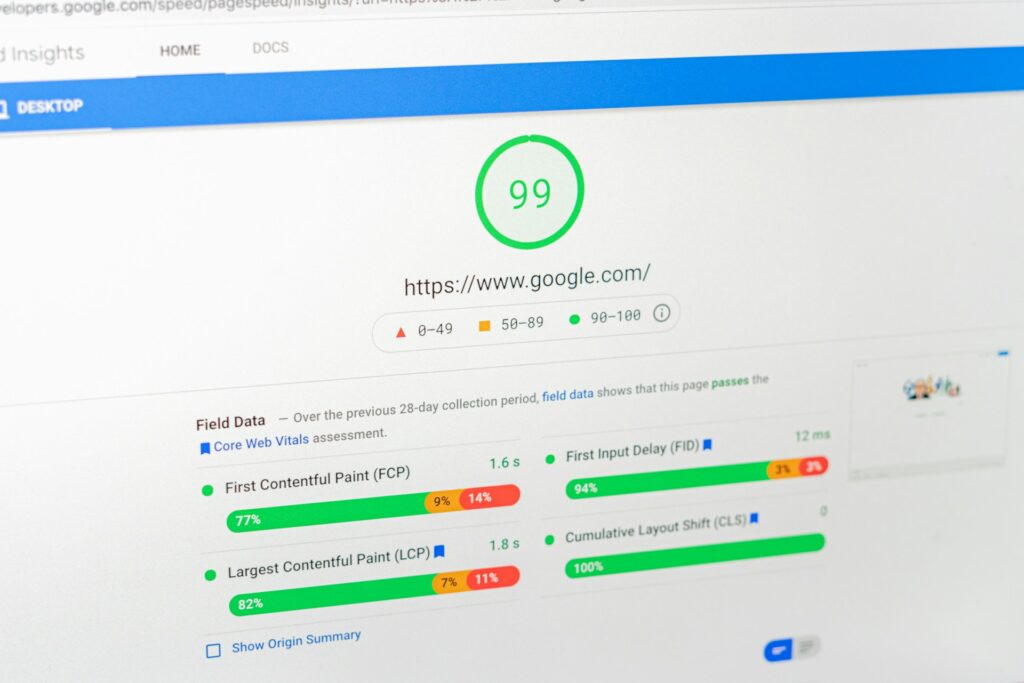
Page speed is a confirmed ranking factor. Slow pages frustrate visitors and hurt your search engine ranking. Compress images, remove scripts you don’t need, and use good hosting.
Mobile friendliness is just as big. Google indexes the mobile version of your site first, so if your pages are hard to use on a phone, your rankings suffer everywhere. Test your pages on an actual phone, not just a shrunken browser window.
9. Structured Data
Structured data is extra code (usually schema markup) that tells search engines exactly what’s on your page: a product, a recipe, an FAQ, a review. It can earn you rich results in the SERPs, like star ratings or FAQ dropdowns, which stand out and pull more clicks.
It’s a small piece of technical SEO that pairs well with the rest of your on-page work.
10. On-Page SEO vs Off-Page SEO
People mix these up all the time, so here’s the clean split.
On-page SEO is everything you do on your own site: content, titles, headings, internal links, images, speed, structured data. Off-page SEO is everything that happens away from your site, mainly backlinks from other websites pointing to yours.
On-page and off-page SEO work as a team. On-page tells Google your page deserves to rank. Off-page tells Google other sites agree. You need both, but on-page comes first. Building links to a poorly optimized page is like pouring water into a leaky bucket.
Common On-Page SEO Mistakes to Avoid
Even experienced site owners fall into these traps. Check your site against each one.
- Duplicate title tags and meta descriptions. Every page needs its own unique title and description. Duplicates confuse search engines about which page to show, and they waste your chance to target different keywords.
- Thin content. Pages with barely any useful information rarely rank. If a page doesn’t answer the searcher’s question better than what’s already out there, expand it or combine it with a stronger page.
- Keyword stuffing. Repeating your keyword over and over doesn’t help. It reads terribly and Google is good at spotting it. Use your keyword naturally, then write for the reader.
- Ignoring search intent. A product page won’t rank for an informational question, and a blog post won’t rank where Google shows product pages. Match the format to the intent before anything else.
- Orphan pages. These are pages with no internal links pointing to them. Google struggles to find them, and visitors never see them. Every important page should be reachable from somewhere else on your site.
- Unoptimized images. Huge file sizes slow your pages down, and missing alt text wastes an easy optimization win. Compress every image and describe it properly.
- Stale content. Information ages. Pages with outdated stats, old years in the title, or dead advice slip in the rankings over time. Refresh your important pages regularly to keep your SEO performance steady.
How to Approach an On-Page SEO Audit (Step by Step)
An on-page SEO audit sounds bigger than it is. Work through this checklist one step at a time and you’ll cover everything important.
- Step 1: List your pages. Run your site through an SEO checker or site audit tool to get a full list of your URLs. This gives you the map for everything else.
- Step 2: Check titles and descriptions. Look for missing, duplicate, or overlong title tags and meta descriptions. Rewrite them so each page has a unique, keyword-focused pair.
- Step 3: Review content and intent. Pick your most important pages and ask: does this fully answer what the searcher wants? Compare against the pages currently ranking at the top and close the gaps.
- Step 4: Fix heading structure. One H1 per page, logical H2s and H3s underneath, keywords included where they fit naturally.
- Step 5: Strengthen internal links. Add links between related pages with descriptive anchor text, and hunt down orphan pages so nothing important sits unlinked.
- Step 6: Check images, speed, and mobile. Compress heavy images, add missing alt text, and test load times. Then browse your key pages on a phone.
- Step 7: Add structured data. Mark up products, FAQs, and articles where it makes sense, so your listings can earn rich results.
- Step 8: Track and repeat. Use Google Search Console to watch rankings, clicks, and click-through rate after your changes. On-page SEO success comes from repeating this cycle, not from one big cleanup.
Why Work with Version for Your On-Page SEO
You can do a lot of this yourself. But if you’d rather have a team handle it, Version builds on-page optimization directly into its SEO programs. Their process goes past basic checklists: title tags and meta descriptions get A/B-tested against your actual click data, content gets restructured so visitors stay and read, and their specialists handle the technical SEO details most teams skip, from schema to Shopify-specific fixes.
The difference is they don’t stop at the page. On-page work, authority backlinks, and engagement signals run together in one system, which is how they’ve scaled 200+ brands. You can start with a free SEO audit and they’ll show you the highest-impact fixes for your site, backed by data, before you commit to anything.
Conclusion
On-page SEO is the foundation everything else sits on. Get your titles, content, structure, links, and speed right, and every other part of your marketing works better.
The best part is how doable it is. None of the on-page SEO techniques in this guide require special tools or a big budget. They require attention. Pick your most important page, run it through the steps above, and start there. Small fixes, repeated across your site, are how rankings grow.
Frequently Asked Questions
1. What’s the difference between on-page and off-page SEO?
On-page SEO covers everything on your own website: content, titles, headings, internal links, images, and speed. Off-page SEO covers signals from outside your site, mainly backlinks. You control on-page fully, which is why it’s the best place to start.
2. How long does on-page SEO take to work?
Small fixes like titles and descriptions can move click-through rate within weeks. Bigger changes like content improvements usually take two to three months to show up in rankings, since Google needs time to recrawl and reassess your pages.
3. What are the most important on-page SEO factors?
Content quality and search intent come first. After those, the title tag, heading structure, internal links, and page speed carry the most weight. Get those right and you’re ahead of most sites.
4. Can I do on-page SEO myself?
Yes. Most on-page SEO best practices are straightforward: write clear titles, answer the searcher’s question, structure your headings, link your pages together, and keep your site fast. Tools like Google Search Console are free and show you exactly what to fix.
5. How often should I update my on-page SEO?
Review your most important pages every few months, and refresh content whenever information goes out of date. Treat it as an ongoing habit rather than a one-time project.
